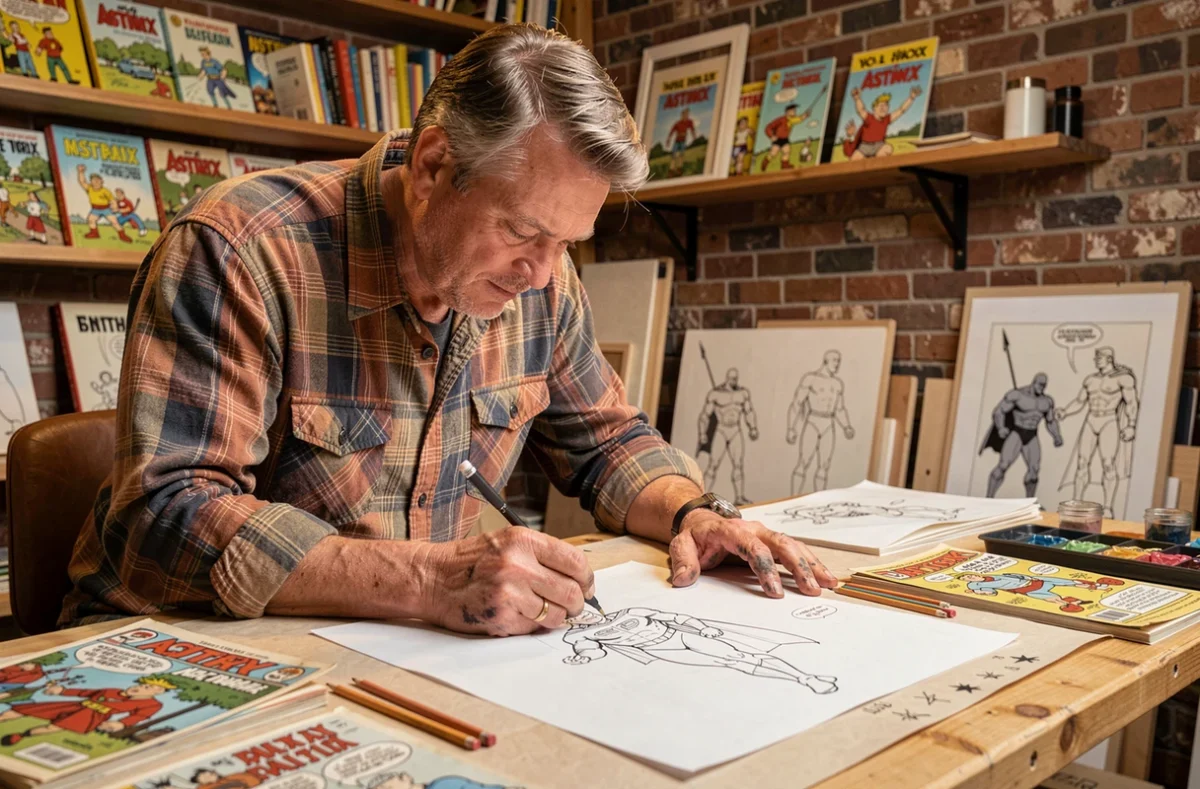
The comic strip is not just a gallery of cute mascots. Behind every hero that spans decades, there is a precise narrative device, a calibrated graphic style, and an editorial mechanism that fixes the character in collective memory. We observe that comic book characters that achieve legendary status share identifiable structural characteristics, far beyond mere likability.
Graphic Construction of Lasting Comic Book Heroes: The Trait that Fixes Memory
A comic book character becomes iconic when their silhouette is recognizable in silhouette form. This rule of graphic readability, inherited from animation, remains the first filter of longevity in Franco-Belgian comics as well as in American comics.
The deliberate morphological simplification is the common denominator of enduring characters. Tintin’s tuft, Asterix’s nose, Lucky Luke’s hat function as pictograms. They allow for instant identification at any size of reproduction, from a postage stamp to a wall poster.
Two graphic schools stand out in the construction of these icons. The so-called “big nose” school (Franquin, Uderzo, Morris) relies on expressive distortion: the proportions of the body are deliberately skewed to amplify the character’s traits.
The realistic school (Jacobs with Blake and Mortimer, Hermann, Jean Giraud under the name Moebius) bets on anatomical precision and the setting to anchor the hero in a credible universe. Both approaches produce iconic comic book figures, but through opposing paths.
The choice of color palette plays an equally structuring role. The characters most firmly rooted in collective memory wear sharp primary colors: Spirou’s blue, Tintin’s yellow sweater, the red tunic of Spirou after his wardrobe overhaul. This color saturation is not coincidental: it ensures readability in bichromy on the pages of period magazines.
Narrative Mechanics of Cult Comic Book Characters: Seriality and Dramatic Tension
A comic book hero does not survive several decades of publication without a reproducible narrative engine. Seriality imposes a balance between repetition and renewal that most authors take several albums to calibrate.
Take Asterix, for example. The narrative structure of each volume relies on an almost ritualistic pattern: external threat, quest or journey, magic potion, final banquet. This rigid framework paradoxically liberates humor, which unfolds in variations and wordplay. The reader knows where they are going, allowing them to savor the journey.
In contrast, a series like Blueberry (Jean Giraud on art, Jean-Michel Charlier on script) builds its characters on a long dramatic progression. The hero ages, accumulates scars, loses allies. This feuilleton-like approach, closer to the novel, produces another type of loyalty among readers: not the comfort of repetition, but the curiosity of what comes next.
The Role of the Duo and Secondary Casting
Absolute solitary heroes are rare in comics. The majority of cult characters function in pairs or trios, each member fulfilling a specific narrative function:
- The complementary duo by physical and psychological contrast (Asterix and Obelix, Spirou and Fantasio, Blake and Mortimer) creates a dynamic of ongoing dialogue that propels the plot without resorting to an external narrator.
- The comic satellite character (Gaston Lagaffe with Fantasio, Captain Haddock with Tintin) helps to diffuse dramatic tension and broaden the tonal range of the series.
- The recurring antagonist (Rastapopoulos, the Daltons, Olrik) provides an inverted mirror of the hero and ensures serial continuity without having to reinvent a conflict in every volume.
A hero without a recurring antagonist loses their narrative anchor after a few albums. This is one of the reasons why some adventure series lose momentum when their authors multiply disposable enemies.
Female Comic Book Characters and the Renewal of Iconic Figures: Beyond the Secondary Character
The very notion of “iconic figure” in comics is transforming. In recent years, comic book publishers, both in the Franco-Belgian scene and in American comics, have highlighted a new generation of female characters with complete narrative autonomy.
At Marvel, Kamala Khan (Ms. Marvel) and Miles Morales (co-icon Spider-Man) illustrate a precise editorial strategy: to create characters that are not mere gendered or ethnic variations of an existing hero, but protagonists with their own dramatic arc and their own universe. Streaming and cinematic adaptations accelerate this process of canonization.
In European comics, the movement takes a different form. Female authors like Catherine Meurisse construct narratives where feminine subjectivity structures the entire narrative device, not just one character. The graphic novel allows for this structural freedom that the classic series with recurring heroes does not always offer.
Science Fiction, Fantasy, and Historical Comics: The Genres that Create Legends
Not all genres produce cult heroes with the same efficiency. Franco-Belgian humor and adventure comics historically dominate the pantheon of iconic characters, but science fiction and fantasy have also spawned figures of comparable longevity.
Valerian and Laureline (Christin and Mézières) remain the reference duo in European sci-fi. Their spatiotemporal universe has influenced the design of cinematic productions well beyond the comic book circle. In fantasy, the Thorgal series (Van Hamme and Rosinski) has proven that a hero can combine Norse mythology and family intimacy over several dozen volumes without collapsing narratively.
Historical comics produce heroes of a different kind. Characters like Alix (Jacques Martin) or the protagonists of Jacques Tardi’s series set in World War I do not rely on individual charisma, but on the documentary strength of the narrative that carries them. The hero becomes a vector of historical immersion rather than an isolated icon.
What distinguishes an “iconic” comic book figure from a simply popular character is its ability to function outside its original medium. When a hero transitions from magazine to book, from book to screen, from screen to merchandise without losing its graphic readability or narrative coherence, it has crossed the threshold. The characters who achieve this can be counted on the fingers of a few hands, across all eras and genres.