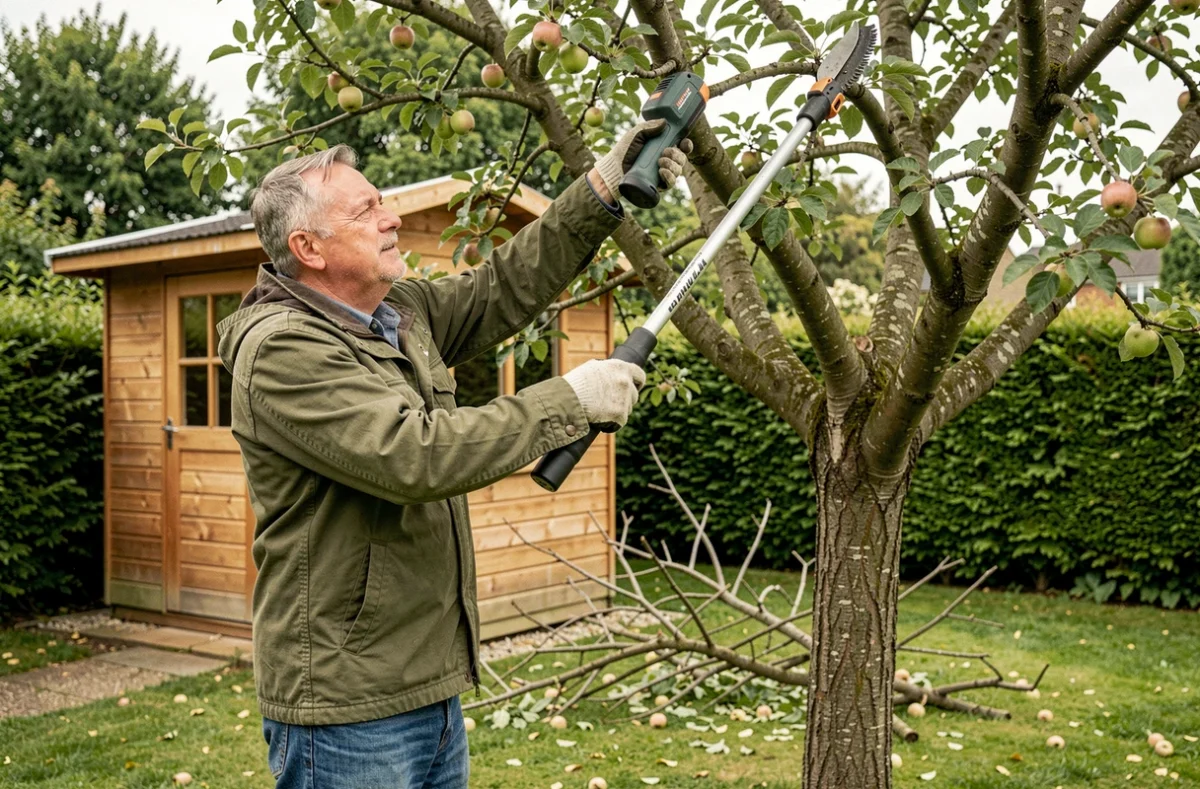
A pole saw is a lightweight chainsaw designed to cut branches at height with one hand. This technical definition influences everything else: weight, guide length, type of motorization, and the associated safety rules. Choosing the right model involves considering the diameter of the targeted branches, the actual working height, and the frequency of use.
Hand-held saw or pole saw: two tools for two situations
The confusion between these two categories skews many purchasing decisions. A hand-held saw (top handle) is operated with one hand, at height, from a harness or platform. Its guide rarely exceeds thirty centimeters. It is used for precise cuts on small to medium diameter branches, directly within the crown of the tree.
The pole saw, on the other hand, is operated from the ground. The cutting head is attached to the end of a telescopic or fixed tube. The advantage is clear: both feet remain on the ground, reducing the risk of falling. However, the reach claimed by manufacturers deserves a critical look.
A pole and raised arms allow an average adult to reach about four and a half meters. This value depends on posture, terrain stability, and muscle fatigue. Comparing technical specifications on elagueuse-warrior.com helps assess pole lengths relative to real-world conditions, rather than relying solely on manufacturer data.
A pole saw does not replace crown pruning, and vice versa. For a garden with moderately tall fruit trees, the pole is sufficient. For interventions in a dense canopy, the hand-held saw remains the appropriate tool.
Gas, battery, or corded motorization: technical choice criteria
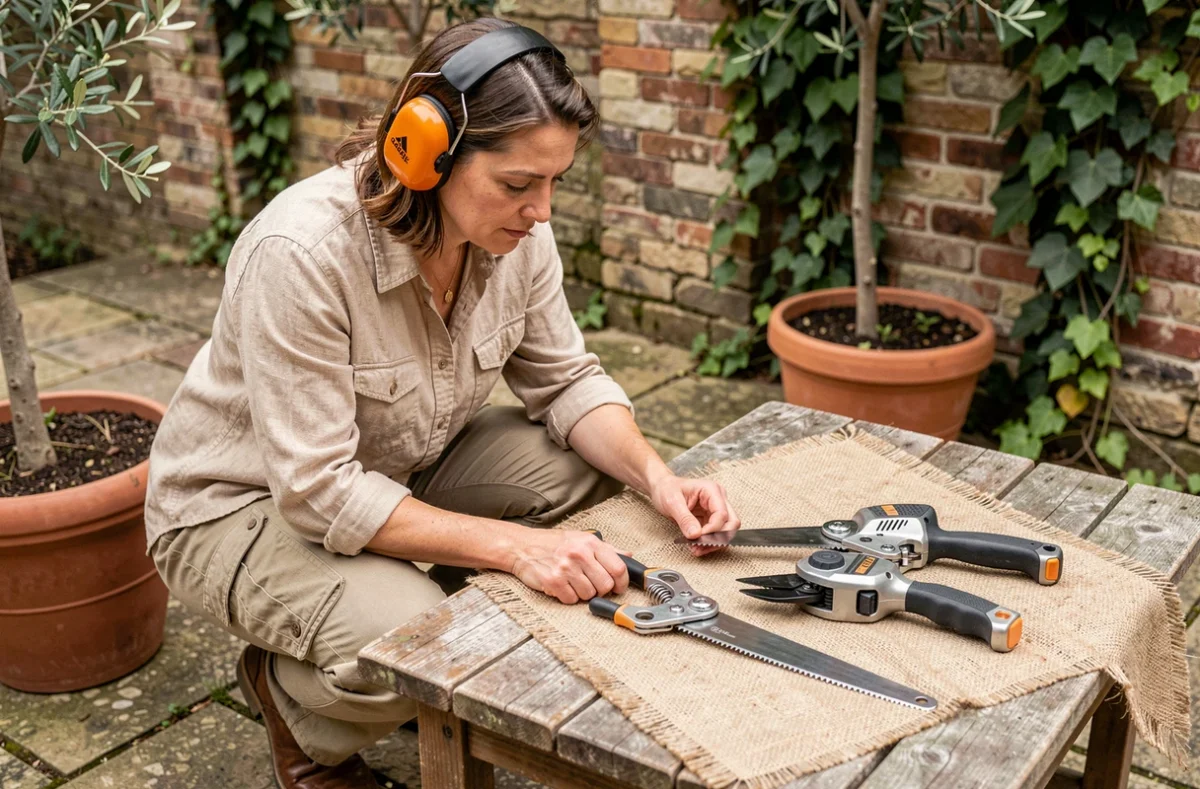
The type of power supply determines autonomy, weight, and noise level. Three families coexist in the market, each with clear trade-offs.
Gas pole saw
The two-stroke engine offers the best raw power and autonomy limited only by the tank. The weight is higher, as is the noise. This type is suitable for professionals or owners of large wooded areas who regularly prune.
Battery pole saw
The lithium-ion battery has made up some of the power deficit compared to gas in recent years. The gain in maneuverability is significant: less vibration, no oil-gas mixing, instant start. The limitation remains autonomy, which varies depending on battery capacity and cut diameter. For occasional garden use, it often represents the best weight-performance compromise.
Corded pole saw
Reserved for entry-level pole saws, the corded version eliminates the recharging constraint but imposes a cable that limits the working radius. It is suitable for hedges or low branches, not for high pruning.
- Gas: maximum power, long autonomy, high weight and noise, regular engine maintenance.
- Battery: lightweight, low noise, variable autonomy depending on the battery, suitable for intermittent use.
- Corded: low entry price, no mobile autonomy, limited to work close to a power outlet.
Guide bar and chain: often overlooked parameters
The length of the guide bar determines the maximum cutting diameter. A short bar (around twenty centimeters) is sufficient for thin branches and offers better maneuverability. A longer bar allows for tackling thicker wood but adds weight to the tool and increases the risk of kickback.
The chain pitch affects the finesse and speed of the cut. A reduced pitch produces cleaner cuts with less vibration, which protects the tree’s tissues and limits entry points for diseases. Low kickback chains should be prioritized for any non-professional user.
An overly long guide on a weak motorization causes the chain to slow down under load, increasing the risk of blockage. The balance between engine power and guide length is the technical parameter to check first on the product sheet.
Safety and regulations regarding pole saws
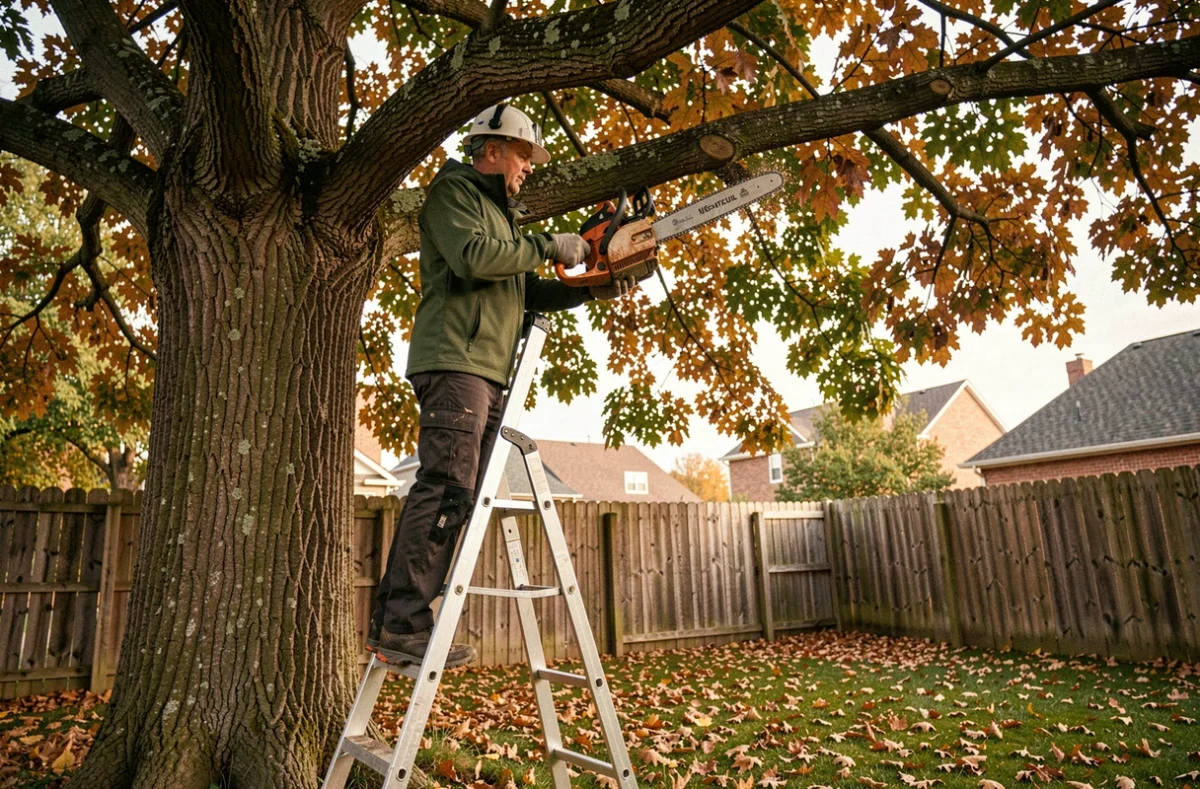
The use of a hand-held saw on the ground is prohibited in France. This rule surprises many individuals, but it stems from the very design of the tool: the top handle does not guarantee a secure two-handed grip during ground cutting. To work on the ground, a standard chainsaw with a rear handle is mandatory.
Regarding personal protective equipment, the minimum includes:
- A helmet with visor and integrated hearing protection, suitable for chip projections and the noise level of gas models.
- Cut-resistant gloves compliant with current standards for chainsaw work.
- Cut-resistant trousers or chaps, even for occasional use.
- High safety shoes with puncture-resistant soles.
The proximity of a power line constitutes a total exclusion case for the use of a pole saw, pole, or ladder. Electrocution can occur without direct contact with the cable, simply through an electric arc in humid air. In this case, only a qualified professional associated with the network manager can intervene.
Mandatory training for employees
In France, the employer must organize practical and appropriate safety training for any employee required to use a chainsaw or pole saw (Labor Code, articles L.4121-1 and R.4141-1 to R.4141-10). The often-mentioned “chainsaw license” is not a general legal obligation. This distinction directly impacts the choice of equipment in a professional context: a model compatible with documented training protocols is necessary.
The choice of a pole saw boils down to three concrete trade-offs: pole or hand depending on the actual working height, motorization based on frequency and environment, guide length based on branch diameter. The regulations regarding ground use and electrical safety are not a minor detail; they serve as a filter that eliminates certain configurations even before comparing prices.